How to Deal With Anxiety: Symptoms, Causes, and a Simple Way to Feel Better

Anxiety doesn’t always look like panic. Sometimes it’s a tight chest before a meeting, a racing mind at 2 AM, or a constant low-level feeling that something’s wrong — even when nothing actually is. If this sounds familiar, you’re far from alone. Anxiety is one of the most common mental health challenges today, and understanding it is the first step toward managing it.
In this article, we’ll cover what anxiety actually is, its most common symptoms, how it connects to overthinking, and a simple approach that can help you feel more in control.
Does Depression Cause Overthinking — Or Is It Anxiety?
A lot of people search this exact question, and the honest answer is: it works both ways. Overthinking, anxiety, and low mood often feed into each other in a loop:
- Anxiety triggers racing, repetitive thoughts (overthinking)
- Overthinking increases stress and worry (fueling anxiety)
- Prolonged stress and worry can contribute to low mood and depression over time
So instead of asking “which one causes the other,” it’s more useful to ask: how do I interrupt this cycle? That’s where understanding your symptoms — and having a clear plan — makes the biggest difference.
Common Symptoms of Anxiety

Anxiety shows up differently for everyone, but the most common signs include:
- Restlessness or feeling constantly “on edge”
- Racing or repetitive thoughts you can’t switch off
- Difficulty concentrating or your mind “going blank”
- Muscle tension, headaches, or a tight chest
- Trouble falling or staying asleep
- Irritability over small things
- A constant sense that something bad is about to happen, without a clear reason
If several of these feel familiar, it doesn’t mean something is “wrong” with you — it means your nervous system has been running in overdrive, often for longer than you’ve realized.
What Causes Anxiety to Build Up?

Anxiety rarely comes from one single event. More often, it builds gradually from:
- Chronic stress (work, finances, relationships)
- Lack of sleep, which lowers your ability to regulate emotions
- Constant exposure to negative news or social media comparison
- Unprocessed worry that never gets “closed out” — so your brain keeps replaying it
- Avoidance — the more we avoid a feared situation, the bigger it feels over time
Understanding the why behind your anxiety is helpful, but on its own, it doesn’t stop the spiral. What actually helps is having a practical, repeatable method to use in the moment when anxiety spikes.
How to Deal With Anxiety: A Practical Approach
Generic advice like “just relax” or “stop worrying” rarely works when your body is already in a stress response. What helps more is a structured method you can return to every time:
- Name it – Simply acknowledging “this is anxiety” reduces its intensity almost immediately; it separates you from the thought.
- Ground yourself – Bring your attention back to your body and surroundings (breath, feet on the floor, what you can see/hear).
- Challenge the thought – Ask: is this a real, solvable problem right now, or my mind predicting worst-case scenarios?
- Take one small action – Anxiety shrinks with action and grows with avoidance. Even a tiny step forward helps.
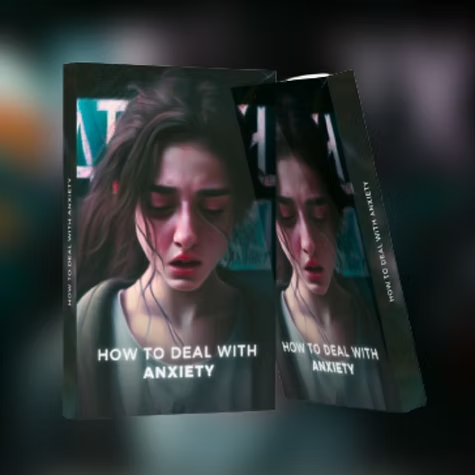
[IMAGE 3 — Product mockup of the “How to Deal With Anxiety” ebook. Place right before this paragraph — builds trust and increases clicks.]
This is exactly the kind of structured, step-by-step support covered in the How to Deal With Anxiety ebook. Instead of vague advice, it walks you through practical tools you can use the moment anxiety shows up — so you’re not left guessing what to do in the middle of a stressful moment.
👉 Check out the How to Deal With Anxiety ebook here
When to Consider Extra Support
Self-help tools and structured guides can make a real difference for everyday anxiety and stress. However, if anxiety is significantly affecting your daily life, relationships, or ability to function, it’s worth also speaking with a doctor or licensed therapist — they can offer support that’s tailored specifically to you.
[IMAGE 4 — Calm, peaceful nature or lifestyle image (contrast image). Place right before the final section.]
Final Thoughts
Anxiety can feel overwhelming, but it’s also one of the most manageable mental health experiences — especially once you have a clear, practical system instead of relying on willpower alone. Small, consistent steps make a bigger difference than most people expect.
If you’re tired of feeling stuck in your own head and want a simple, structured way to manage anxiety day to day, the How to Deal With Anxiety ebook is built exactly for that.