
Can Overthinking Cause Depression? Signs, Effects on the Brain, and How to Stop

Overthinking feels harmless at first. A small worry loops in your head, you replay a conversation, you imagine worst-case scenarios before they happen. But over time, this habit can quietly reshape your mental health — and yes, research increasingly links chronic overthinking to depression and anxiety.
In this article, we’ll break down what overthinking really does to your brain, the warning signs of an overthinking disorder, and a simple, practical way to break the cycle.
Can Overthinking Cause Depression?

The short answer: yes, in many cases it can contribute to it.
Overthinking usually shows up in two forms — rumination (dwelling on the past) and worry (obsessing over the future). Both keep your mind stuck in a loop of negative thought patterns. When this becomes chronic, it can:
- Increase cortisol (the stress hormone) levels
- Disrupt sleep, which worsens mood regulation
- Reinforce negative self-talk and low self-worth
- Make it harder to take action, leading to feelings of helplessness
Psychologists often describe this as a feedback loop: overthinking causes stress → stress lowers mood → low mood increases overthinking. Left unchecked, this loop is one of the most common pathways into depressive symptoms.
(A structured system that interrupts this loop early — before it spirals — is often more effective than trying to “just stop thinking.” More on that below.)
Overthinking's Effects on the Brain
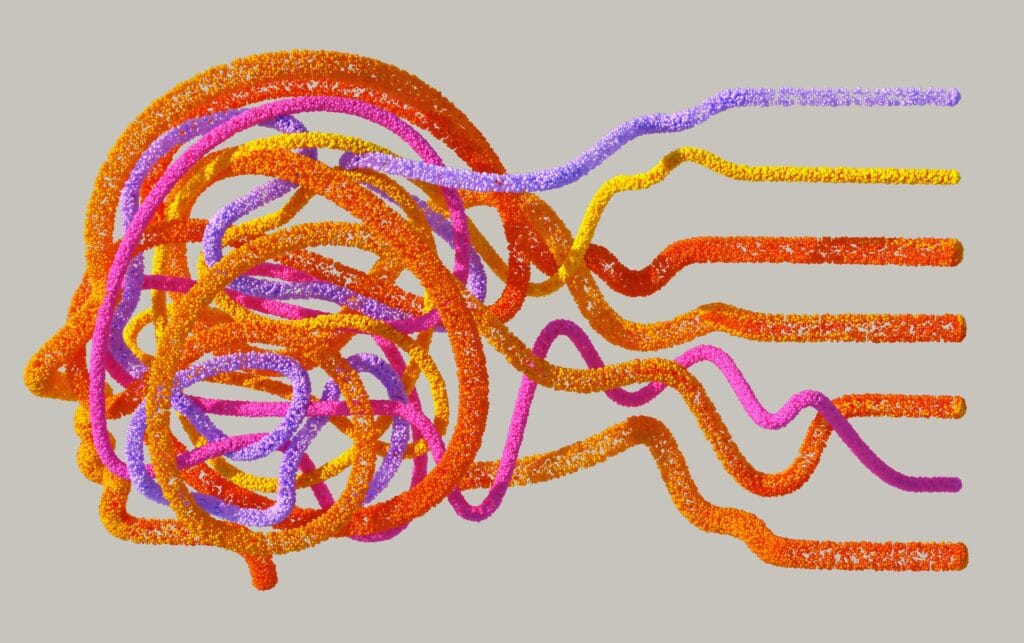
Overthinking isn’t just a mindset problem — it has measurable effects on brain function.
1. Overactive amygdala The amygdala is your brain’s threat-detection center. Constant worry keeps it in a heightened state, making you more reactive to stress even in normal situations.
2. Reduced prefrontal cortex efficiency This is the part of your brain responsible for decision-making and rational thinking. Chronic overthinking overworks it, leading to mental fatigue, indecisiveness, and brain fog.
3. Disrupted default mode network (DMN) The DMN is active when your mind wanders. In overthinkers, this network becomes hyperactive, which is strongly associated with both anxiety and depressive rumination in neuroscience research.
In simple terms — overthinking trains your brain to treat imagined problems like real threats, keeping your nervous system in a constant low-grade “alert” mode.
Side Effects of Overthinking (Beyond Just Stress)

Overthinking doesn’t just affect your mind — it spills into daily life:
- Relationships – misreading intentions, seeking constant reassurance
- Work performance – procrastination from fear of imperfect decisions
- Physical health – tension headaches, poor sleep, fatigue
- Self-esteem – reinforced negative self-beliefs over time
This is why addressing overthinking early matters — it’s rarely “just in your head.”
How to Not Overthink: A Simple 4-Step Approach

Most advice on overthinking is vague — “just relax” or “think positive” doesn’t actually work when your brain is stuck in a loop. What helps more is a structured, repeatable process you can use in the moment.
A simple framework that works well:
- Catch – Notice the thought spiral as it starts, before it snowballs
- Calm – Use a quick technique (breathing, grounding) to lower the stress response
- Clarify – Separate real problems from imagined ones
- Continue – Take one small action instead of staying stuck in thought
This is exactly the kind of system covered in the Stop Overthinking Guide — a digital workbook built around this 4-step Catch → Calm → Clarify → Continue method, plus a 7-day mental reset plan. It’s designed for people who don’t want more theory, just simple exercises they can actually use when their mind starts spiraling.
How to Not Overthink: A Simple 4-Step Approach
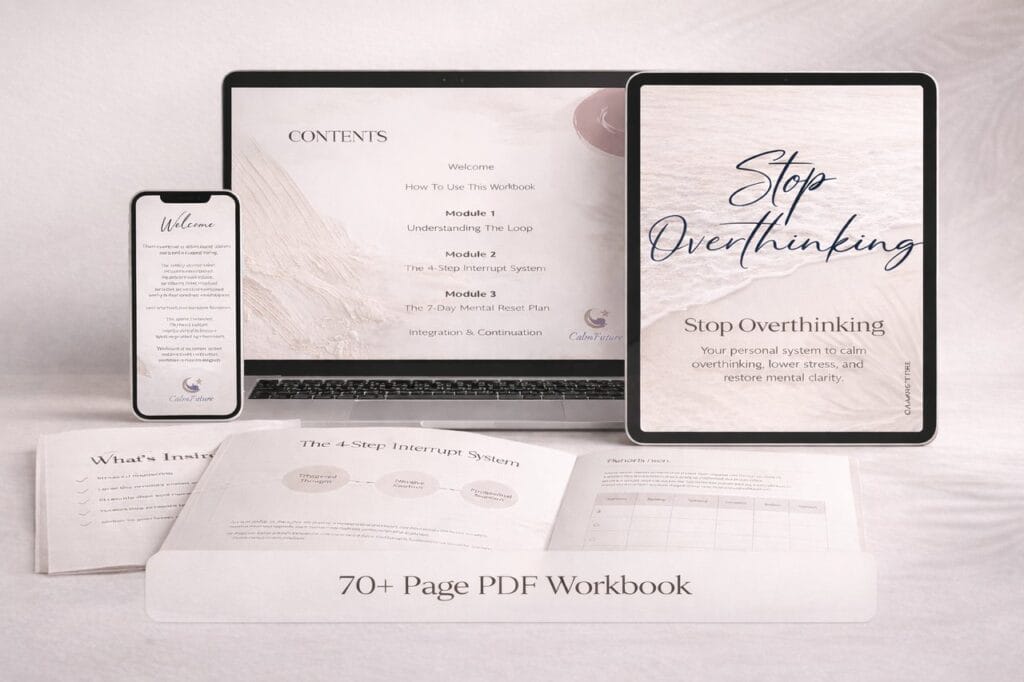
👉 Check out the Stop Overthinking Guide here
Final Thoughts
Overthinking is more than a bad habit — left unmanaged, it can affect your brain, your relationships, and your mental health over time. The good news is that it’s a learnable skill to manage, not a permanent trait.
If you constantly find yourself stuck in your own head, replaying situations, or unable to make simple decisions without spiraling, it may be worth trying a structured approach instead of relying on willpower alone.
The Stop Overthinking Guide offers exactly that — a simple, actionable system to catch overthinking early and break the cycle before it affects your day.